Ai-Based Vs Traditional Digital Marketing | Which Is Better?
Quick Highlights
- AI tools can speed up research, reporting, and
routine marketing tasks.
- Traditional methods give marketers direct
control over creative decisions.
- Human review helps keep AI-generated content
accurate and useful.
- SEO success depends on helpful content and sound
technical practices.
- Choose tools based on goals, budget, skills, and
customer needs.
- Track leads, sales, engagement, and costs to
judge campaign results.
Are you confused about choosing AI-based vs traditional
digital marketing for your business? Both approaches can help you reach
customers, promote products, and generate leads.
However, they use different methods to plan campaigns,
understand customer needs, and measure results.
Our highly experienced digital marketers in Delhi NCR
are explaining how they differ, their benefits and limitations, and how you can
choose the right approach for your business in this useful article.
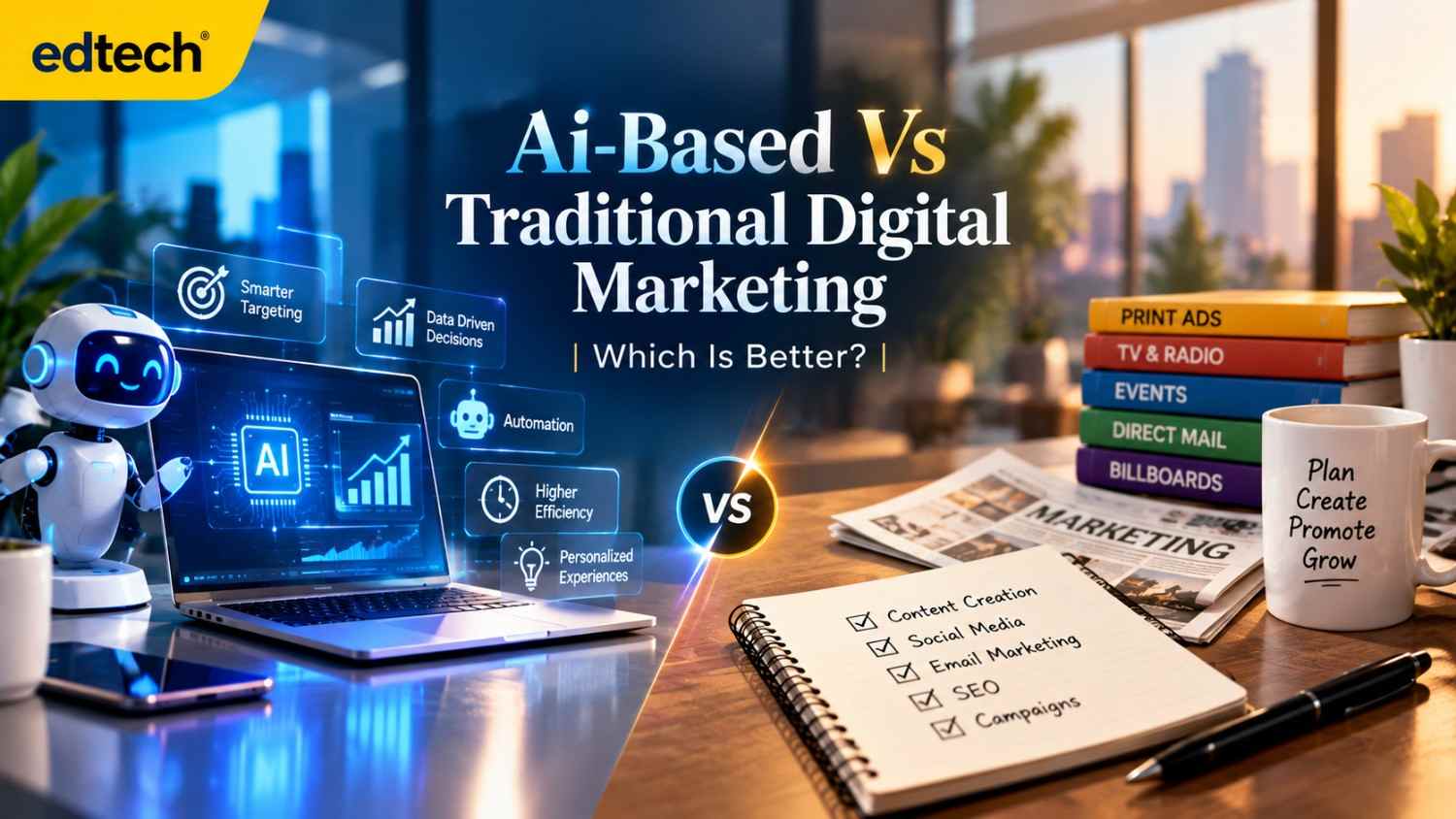
What Is the Difference Between AI-Based and Traditional Digital Marketing?
AI-based digital marketing uses artificial intelligence to
study data, understand customer behaviour, create content, and support
marketing decisions.
Traditional digital marketing relies more on human research,
manual planning, experience, and standard marketing tools.
Both approaches use digital channels such as search engines,
social media, email, and websites. The main difference lies in how marketers
plan tasks, analyse information, and adjust their campaigns.
For example, a traditional marketer may review website
reports manually to find popular pages. An AI-based approach may analyse the
same reports and identify patterns in customer activity. A marketer can then
use those findings to plan better campaigns.
The main differences include:
- Data analysis - Traditional marketing often
relies on manual reports. AI tools can analyse large amounts of data quickly.
- Content creation - Traditional methods depend on
human writing and design. AI tools can help prepare drafts and content ideas.
- Customer targeting - Traditional campaigns use
selected audience groups. AI tools can help identify patterns and suggest
relevant groups.
- Campaign changes - Traditional marketers may
adjust campaigns after reviewing reports. AI tools can support faster decisions
with current data.
- Human control - Traditional methods rely heavily
on human decisions. AI-based methods still need human judgement and
supervision.
How Does AI-Based Digital Marketing Work?
It uses software to analyse information and assist with
marketing activities. These tools can help businesses understand customers,
prepare content, manage campaigns, and measure performance.
Marketers can use AI across different channels, but the
results depend on the quality of the data, the tools, and the instructions they
provide.
For example, an online furniture store may use AI to study
product views and purchase history. The system can suggest related products for
future email campaigns. The marketing team must still check product details and
keep messages relevant.
AI can also support Social Media,
SEO, answer engine optimization, and generative engine optimization. It can
help marketers study search questions, organise content ideas, and identify
information gaps. Human editors must check facts, add useful details, and make
sure the content answers real customer questions.
AI output is not always accurate. Businesses should review
facts, protect customer data, and follow the rules that apply to their
marketing channels.
Common uses include:
- AI content tools can suggest blog topics, draft
social media posts, and prepare email copy.
- AI analytics tools can identify traffic patterns
and highlight pages that need attention.
- Chatbots can answer common customer questions
and direct users towards useful information.
- AI advertising tools can help manage bids and
find audience groups that may respond to ads.
- Email marketing tools can suggest content and
send messages based on customer actions.
What Are the Benefits and Limitations of Traditional Digital Marketing?
It offers direct human control over planning, communication,
and creative decisions. It can work well for businesses that understand their
audience and have clear marketing goals.
This approach uses familiar methods such as keyword
research, manual SEO audits, email campaigns, social media planning, paid
advertising, and performance reports.
However, traditional methods also have limitations. Manual
research can take time, especially when a business handles large amounts of
data. Teams may also miss patterns that are difficult to spot in regular
reports.
For example, a small coaching centre may manually review
enquiries from its website and social media pages. This can work when enquiry
numbers remain manageable. If the centre receives hundreds of enquiries,
automated reporting may help the team sort and review them faster.
Traditional marketing also depends on the skills and
availability of the people managing each campaign. Businesses need a clear
process for tracking results and updating their plans.
Its main benefits include:
- Personal judgement - Marketers can understand
customer concerns and adjust messages with care.
- Creative control - Writers and designers can
develop original ideas around a brand's voice.
- Direct communication - Teams can respond to
customer feedback with a personal touch.
- Clear processes - Small businesses can manage
basic campaigns without complex AI systems.
- Human review - Marketers can check context,
tone, facts, and brand requirements at each stage.
Which Approach Is Better for SEO, Content, and Paid Advertising?
AI-based digital marketing can support faster research and
data analysis. Traditional digital marketing can provide stronger human control
over strategy, creative decisions, and quality checks. The better choice
depends on the task and the business goal.
Which Approach Is Better for SEO?
AI tools can help marketers group keywords, study search
intent, find content gaps, and review website data. Traditional SEO methods
allow experts to assess website structure, page quality, technical issues, and
user needs.
For example, AI can suggest questions for an article about
website speed. An SEO expert can then check those questions and prepare useful
answers. The expert must also review page performance and technical errors.
Which Approach Is Better for Content Marketing?
AI can help create outlines, suggest headings, and prepare
early drafts. Human writers can add clear explanations, real examples, original
ideas, and a natural brand voice.
Businesses should not publish AI-generated content without
proper review. Content must offer value to readers instead of repeating
information already available across search results.
Which Approach Is Better for Paid Advertising?
AI-powered advertising tools can assist with bidding,
audience selection, and campaign analysis. Traditional campaign management
gives marketers direct control over ad copy, budgets, targeting choices, and
testing plans.
For example, a local service business can use automated
bidding to manage ads. A marketer should still check lead quality, advertising
costs, and the number of genuine enquiries.
Neither approach guarantees better rankings, higher sales,
or lower advertising costs. Results depend on the campaign, the audience, the
budget, and the quality of execution.
How Can You Choose the Right Digital Marketing Approach?
Choose an approach based on your business goals, budget,
team skills, and daily marketing needs. You do not need to adopt every AI tool
to improve your results.
A small business may benefit from human-led marketing with a
few AI tools. A large online store may need more automation to manage product
data, customer groups, and advertising campaigns.
Start with one clear problem. For example, use an AI tool to
organise keyword research or prepare email drafts. Compare the time required
and the quality of the results against your existing process.
Track useful measures such as qualified leads, sales,
website conversions, customer engagement, and campaign costs. Keep the methods
that support your goals. Change or remove tools that add work without clear
benefits.
Consider these factors before making a decision:
- Business size - Small businesses can start with
basic tools and add AI when their needs grow.
- Marketing goals - Lead generation, brand
awareness, online sales, and customer support may need different methods.
- Budget - Compare tool fees with the time and
effort they could save.
- Team skills - Choose tools your team can
understand, manage, and review properly.
- Data quality - AI tools need suitable data to
produce useful suggestions.
- Customer expectations - Use automation carefully
when customers need personal support or sensitive advice.
Why Does a Combination of AI and Traditional Digital Marketing Often Work Best?
A combination often works best because AI can handle
repetitive tasks while people guide strategy and protect content quality.
Businesses can use technology for research and analysis without giving up human
judgement.
For example, a marketing team can use AI to review search
queries and suggest article topics. A writer can select the most useful topic
and create content that answers customer questions. An SEO specialist can check technical issues and
review performance after publication.
Businesses must also consider privacy, accuracy, and cost.
They should avoid entering confidential customer details into tools without
checking their data policies. Teams must review AI-generated claims and follow
advertising and data protection rules.
A combined approach still requires clear goals and regular
reviews. AI tools cannot replace a sound marketing plan or guarantee that
customers will respond. Human experts must decide what to publish, whom to
target, and how to measure success.
This approach offers several practical benefits:
- AI can organise data and prepare early content
drafts.
- Human experts can check accuracy and add
relevant context.
- Automated reports can help teams spot
performance changes.
- Marketers can use customer feedback to improve
future campaigns.
- Human review can reduce errors and protect brand
trust.
Final Point Of View
AI-based vs traditional digitalmarketing company is not a choice between technology and people. AI
can speed up research, reporting, and repetitive tasks. Traditional methods
support human judgement, creativity, and personal communication. Businesses
should select tools based on their goals and resources. A balanced approach can
help teams improve marketing work without losing quality or customer trust.